You walk into the living room and there it is again: a row of neat little holes down the arm of the sofa, right where your cat sits. It feels personal, and it is easy to take it personally. But the damage is not a rebellion or a plot. It is a cat doing something cats have always done, in a spot that happens to be expensive.
The good news is that this is one of the most solvable behaviour problems in cat care, and the solution is not stricter rules for the cat. It is a better plan for the room. Most scratches happen because your cat has a job to do and the sofa is the only thing on offer that suits it. Give that cat a scratching surface it prefers more than the sofa, place it where the scratching actually happens, and most sofas survive the year.
Why your cat picked the sofa in the first place
Before you move anything, it helps to understand that scratching is normal, healthy cat behaviour that happens for several different reasons. A single household can have three cats scratching for three different reasons at the same time, which is why a single fix sometimes seems to work for a week and then stops.
It is a message, not a tantrum
Cats have scent glands in their paw pads. When your cat scratches a surface, it leaves both a visible mark and a scent signature that says something close to this is mine, I was here, I am comfortable in this place. For an indoor cat, the sofa in the middle of the living room is a prime piece of real estate for exactly that message.
This is also why scratching often increases when the household changes. A new baby, a visitor, a rearranged room or a cat on the other side of the glass can all make a cat work harder at saying I belong here.
Claws need sharpening, and fabric feels good
Claws grow in layers, and the outer sheath sheds as the claw sharpens. Scratching tears the loose layer away. A rough woven sofa fabric also gives a claw something satisfying to hook into, in a way that a smooth plastic tray never will.
When scratching is about feelings rather than furniture
Some scratching is emotional. Cats scratch when they are excited, when they are frustrated, and when they are trying to work off tension. A cat that watches birds from the window and then attacks the sofa arm is not misbehaving; it is finishing a hunt that never happened.
The rule of thumb: if the scratching is new, sudden, or happening far more often than it used to, treat it as a signal to investigate rather than as a habit to punish. If it is steady, seasonal or tied to a specific spot, you are probably dealing with a preference problem, and preference problems respond well to a better alternative.
Read the timing: what the scratching is telling you
Most owners attack the damage without ever collecting the information that would solve it. Two minutes of watching answers more than any guess.
Look at the hour before it starts
Notice what happens in the run-up to the scratching. Common patterns point straight at the cause.
- After a noisy or busy hour. The dishwasher, a delivery, guests, a screaming child. The cat is discharging tension, and the sofa is the safest target in the room.
- Just after waking or just before dusk. This is prime cat activity time, and it is when training sessions land best.
- Straight after another animal left the room. That is scent marking, and it is a social signal rather than a furniture complaint.
- Right after a play session. The hunt ends, the energy has to go somewhere, and the sofa arm is the closest available full-body scratcher.
Keep a one-week note
A pocket notebook is enough. For one week, jot down the time, the room, what happened just before, and whether the cat was calm or wound up. By the end of the week most owners can see the pattern in three glances, and the right post, the right timing and the right enrichment all follow from it.
Give your cat a scratching post worth choosing
Scratching posts fail far more often because of placement and surface than because of price. You can spend more and change nothing, or spend modestly and place it perfectly.
Put it beside the sofa, not across the room
This is the single biggest mistake. A beautiful scratching post in the hallway is a scratching post your cat will walk past, because a cat chooses the post that is already on its route between you and the thing it wants.
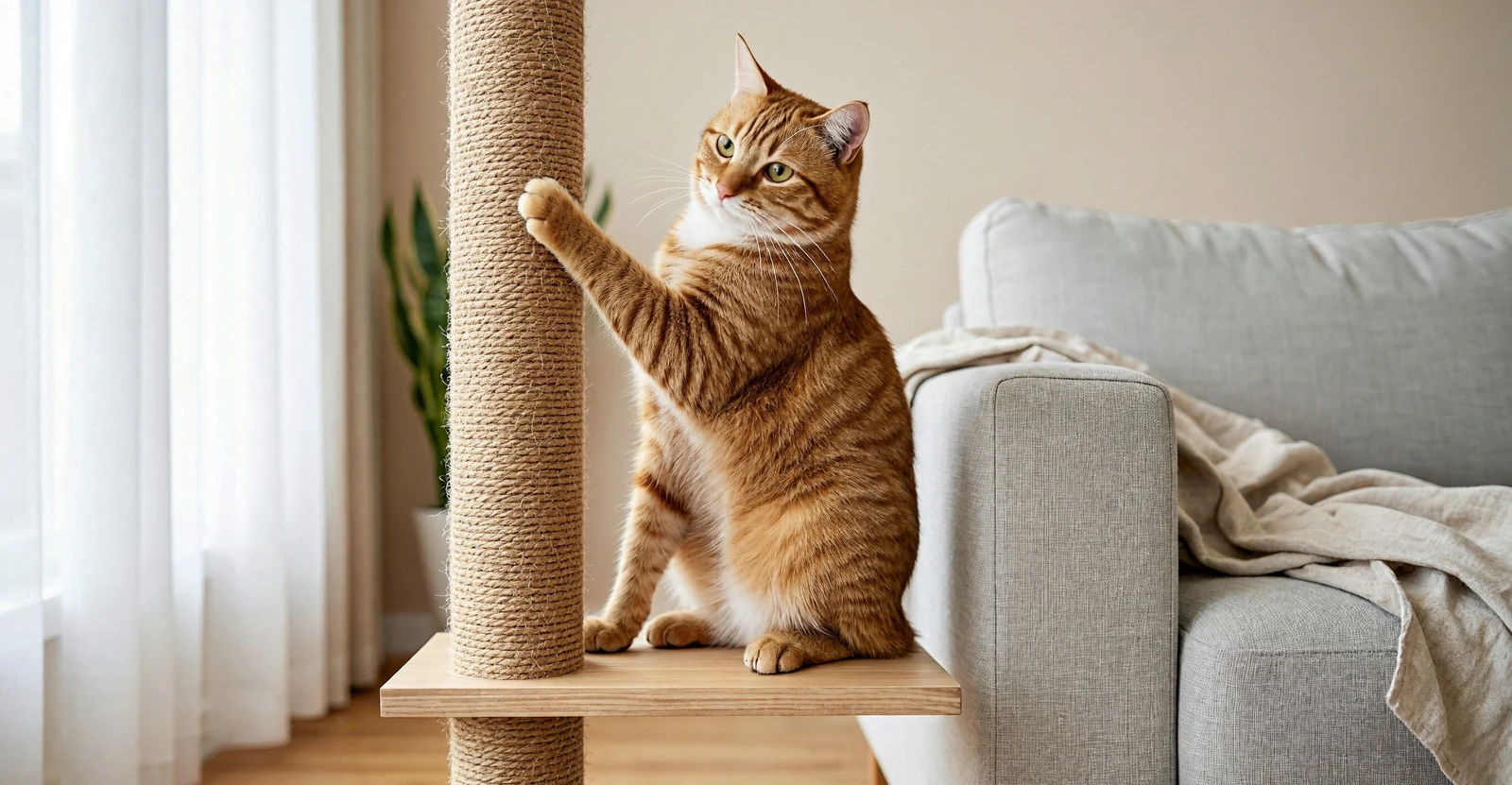
- Place the post near the sofa, a metre or two away, on the side the cat approaches from.
- Put it on the same side of the room as the window or the door your cat likes to watch, so it becomes part of that route.
- If the sofa is in the middle of the room, put the post beside the sofa and let it be visible. A post that blends into a corner is a post that gets ignored.
One post per cat, plus one spare
Cats that live together rarely share a favourite object happily, and a post two cats want becomes a source of friction. Spread them out: one post per cat, plus one extra, each in a different spot. In a one-cat home, two posts in two rooms give the cat a genuine choice, and the second one often becomes the favourite.
Get the height, width and stability right
- Tall enough to stretch. A cat stretches fully when it scratches, front paws high, back legs extended. A post that is too short means the cat cannot finish the movement, and many cats give up halfway.
- Wide enough to work. A vertical post should be at least a paw or two across, so the cat can use both front paws.
- Stable enough to trust. If the post wobbles when the cat leans into it, it gets ignored. A base wider than the post, or one fixed to the wall, solves this instantly.
- Right beside the sofa, not under it. A post wedged under the sofa may be exactly where the cat wants it, and it may also be invisible and unstable. Slide it out into the open first.
Choose a surface cats actually like
| Surface | Why cats choose it | Worth knowing |
|---|---|---|
| Sisal rope | Rough, fibrous, and satisfying to hook into | Durable and widely available; fray if left for years, and shards can be a hazard for chewers |
| Corrugated cardboard | Cheap, light, and easy to scratch | Excellent for cats who ignore everything else; replace when it is chewed through |
| Wood | Solid, cool, and close to a tree trunk | Very durable and long lasting; less appealing to cats who prefer soft textures |
| Fabric or carpet | Familiar texture, especially for carpet-loving cats | Attractive, but it hides the evidence, so you lose your early warning system |
| Horizontal mat or rug | Some cats prefer to scratch flat, especially when they lie down afterwards | Often the answer for a cat who ignores vertical posts; place it near the sofa too |
Most cats will try a post that already looks used. If you can, buy one that has a worn patch, or add a piece of cardboard or an old rug to the top of a new post to give it that look.
Offer both a vertical and a horizontal option
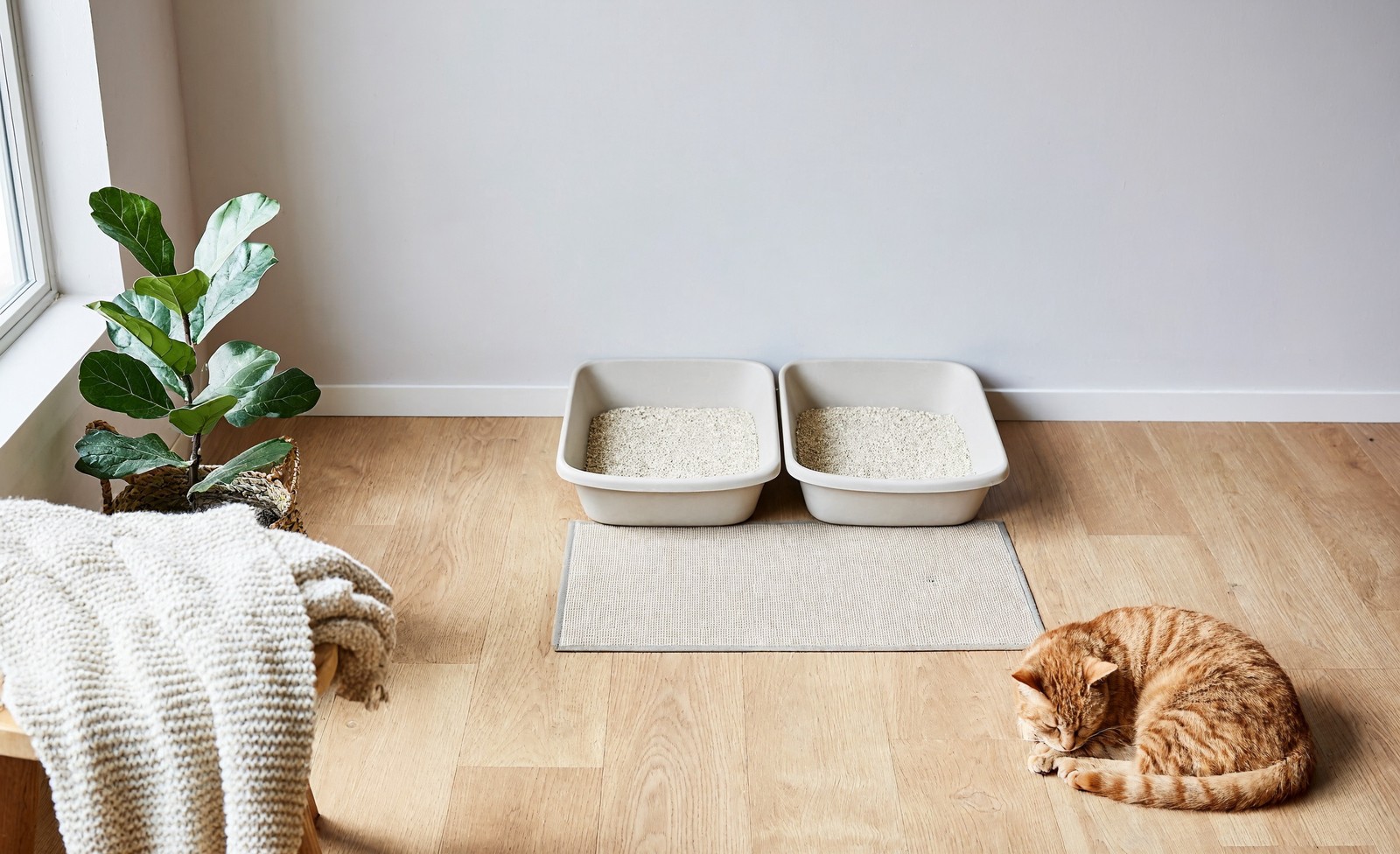
Not every cat scratches upright. Some prefer a flat surface they can rake while lying down, and some like both. One vertical post plus one flat mat placed in the same area as the sofa scratching covers nearly every preference, and it costs far less than the sofa.
Make the sofa less appealing without making it scary
Once a good post exists, a couple of quiet adjustments to the sofa usually finish the job. The goal is to remove the reward, not to start a fight.
Wide double-sided tape
Wide, firm double-sided tape on the arm of the sofa gives the claws something they do not want to grip, and it costs very little. It is not a punishment: the tape simply declines to be interesting.
- Use wide tape, not thin tape, and press it down properly so there are no edges to hook into.
- Test a small patch first, because some fabrics lift or take the tape with them.
- Change the tape every week or two; the sticky surface stops working as it collects fur.
A cover you can live with
A washable throw or a fitted slipcover over the problem arm turns an expensive repair into a laundry item. Many owners find this is the change that finally works, because it removes the grip the claws were enjoying.
- Choose a fabric you are willing to replace without resentment.
- Secure it well, so the cat cannot push it off and scratch underneath it.
- Keep spare covers and wash them on a regular cycle.
Fresh, clean, unscented fabric
Cats are drawn to the scent that has built up on a sofa, and they are put off by strong artificial fragrance. Keep the fabric clean, and skip scented sprays, scented candles and heavily fragranced cleaning products near the furniture.
A seven-day plan that actually works
Training a cat is not about issuing commands. It is about arranging the environment so the behaviour you want is the easiest one, then rewarding it consistently until it becomes the default.
- Days one and two: move, do not scold. Put the post where the scratching happens. If the sofa arm is the target, the post goes beside the sofa. Do not move the cat, do not raise your voice, do not put the cat down next to the scratch and wait for the lesson to land.
- Days three and four: pay for the right choice. The moment your cat scratches the post, say one cheerful word and give a treat. Timing is everything: within two seconds of the right behaviour, or the cat will not connect the two.
- Days five to seven: make the post irresistible. Sprinkle a little of the cat’s favourite treat on the post, hang a toy from the top so the post doubles as a play station, and set it near a window the cat likes. Now the post offers scent, food, height and a view, and the sofa offers none of them.
One thing at a time. Do not move the post, add tape and change the litter all in the same week. Change one variable, give it a week, and you will know what actually worked.
Enrichment that takes the edge off
A cat with a full day does not need to make a hobby of your sofa arm. Enrichment is what removes the underlying restlessness that makes scratching compulsive rather than occasional.
Play that copies hunting
Two or three short sessions a day beat one long one, and the pattern matters more than the toy. A wand toy that moves away from the cat, pauses and rustles under a cover reproduces the stalk, the chase and the catch, which is the sequence cats are wired to finish. Let the cat catch something at the end of every session, even if it is a tissue.
Height, perches and a window seat
Cats that can watch from above feel safer and settle better. A sturdy shelf, a cat tree or a windowsill that fits the cat gives it a lookout, and a lookout is one of the best cures for restless energy. Position the tree so the scratching post on it is visible from the room.
Food puzzles and a toy rota
- Use a puzzle feeder or scatter a few pieces of food around the floor so the cat has to search.
- Rotate three or four toys rather than leaving everything out; novelty is what makes a toy interesting.
- Keep cardboard boxes and paper bags around. A box that can be flattened and re-glued is a free scratching surface that changes shape every week.
When more than one cat is involved
Scent marking between cats
When one cat starts scratching a shared surface, the message may be aimed at another cat rather than at you. A horizontal scratch in the middle of a room is often a deliberate signal left where another cat will find it.
Watch the body language, not just the scratch
- Ears flat, tail lashing, pupils wide? That is fear or overstimulation, and the scratching is a coping behaviour.
- Relaxed posture, slow and rhythmic scratching? That is scent marking, and it is a normal social behaviour.
- Scratching concentrated in one spot, with bald patches or sores? That is not scratching at all. It may be itching, fleas, a skin problem or pain, and it needs a vet.
In multi-cat homes, give each cat its own post, its own resting height and its own escape route, so that one cat cannot be cornered while another uses the good scratching spot.
What to avoid
No punishment
Spraying water, shouting, or physically removing the cat from the sofa mid-scratch all teach the same lesson: that the person is unsafe and that the sofa belongs to the human. It does not teach the cat where to scratch instead, and it can damage the trust that makes a cat comfortable in the room at all.
No declawing
Declawing is not a quick fix for scratching; it is surgery that removes the last bone of each toe. It can leave feet that hurt, change the way a cat walks and balances, and cause problems with using the toilet area. Many countries ban it for that reason, and any vet who offers it should be asked about alternatives first.
No trimming claws as punishment
Claw trims can be part of a sensible routine, especially for indoor cats, but doing them as a consequence for scratching teaches nothing except that the person is unpredictable.
Do not suddenly evict the cat from the sofa
If the sofa is where your cat feels settled, shooing it off every time turns the whole piece of furniture into a contested zone. Move the cat to a spot it likes instead of pushing it out of a spot it wants.
When to call the vet
Behaviour change deserves a check when it arrives suddenly. A cat that has always used a post and suddenly scratches the sofa, or one that starts scratching far more than before, may be dealing with something physical.
- Persistent scratching on one area, especially with hair loss, redness, scabs or sore skin.
- Sudden scratching with no change in the household routine.
- Any sign of discomfort when the paws are touched.
Skin irritation, parasites, pain and anxiety can all show up as scratching, and a vet can rule those in or out quickly. It is worth ruling out a physical cause before you spend a month redecorating.
Your sofa-saving checklist
- At least one scratching post per cat, plus one spare, spread around the home.
- One post within a metre or two of the sofa, on the cat’s usual route.
- Tall, wide and stable, with a surface the cat chooses on its own.
- One horizontal mat or scratcher as well as a vertical post.
- Treats on the post, and praise the instant the cat uses it.
- Wide double-sided tape or a washable cover on the problem arm.
- Two or three hunting-style play sessions a day.
- Height, a window seat and a rotating toy rota.
- No scolding, no spraying, no declawing.
- A vet check if the scratching is new or suddenly more frequent.
Scratching is not a flaw in your cat, and it is not a war against your furniture. It is a job, and your job is to offer a better way to do it: one post, in the right place, with the right surface, rewarded every single time. Cats are creatures of habit in both directions, and a cat that spends two weeks scratching a post it likes rarely goes back to the sofa.